

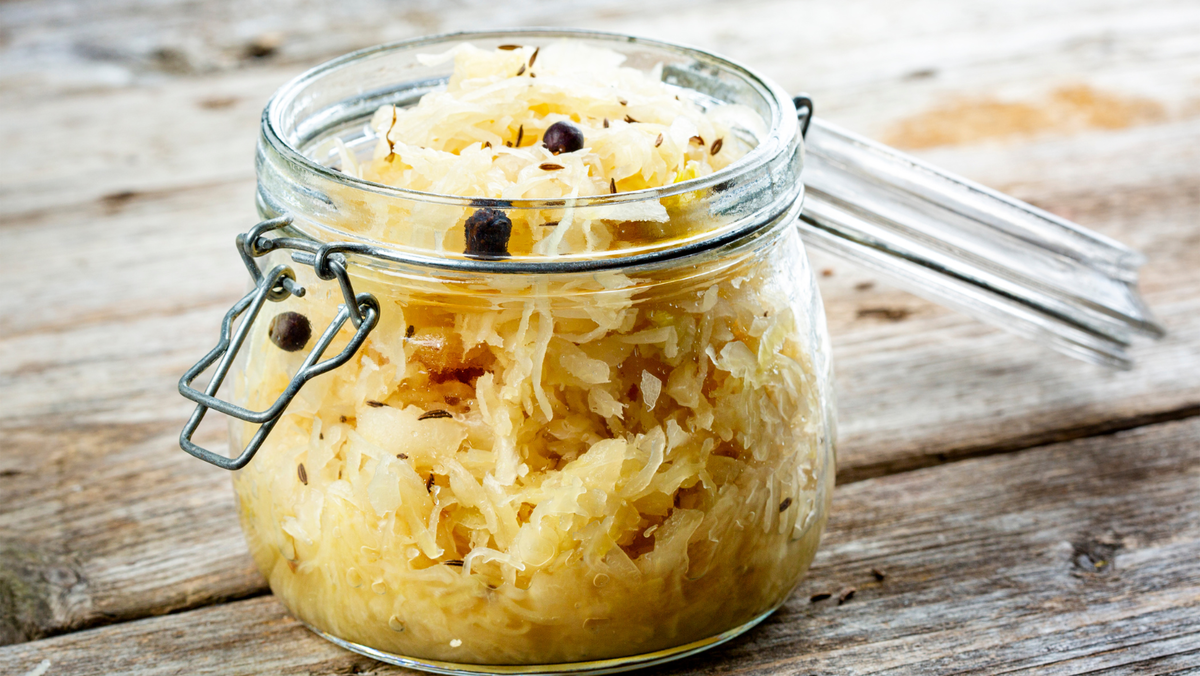
With a little care and attention, and a bit of time, you can make gut-healthy sauerkraut at home.

With a little care and attention, and a bit of time, you can make gut-healthy sauerkraut at home.
Chefs Sarah Montaño & Aaron Sternberg
Varies
30 minutes
German
Snacks
Lacto-fermentation is a biological process where sugars and starches in vegetables and fruit are converted into lactic acid by the many species of lactic acid bacteria. We're harnessing its power here.
This recipe requires a bit of math; to calculate 2% salinity of your cabbage, weigh it dry in grams and multiply by .02. So, 100g of cabbage x .02 would = 20g salt. For 3% salinity, multiply by .03.
This recipe also makes use of a fermentation lock; they can be bought cheaply or DIY'd. Make sure you have adequately large or multiple jars with a fermentation lock for each.
Wash hands with hot soapy water. Wash all jars and equipment with hot soapy water.
Peel and chop garlic, if using. Leave whole for milder flavor.
Wash cabbage. Remove 1 or 2 large outer leaves from the cabbage and set aside. These will be used for covering the sauerkraut.
Measure the dry weight of your remaining cabbage and calculate 2-3% for salinity. This is the amount of salt you will use. Measure salt.
Place cabbage in a glass, ceramic, or steel bowl and sprinkle with salt. Massage salt into the cabbage to create a brine. Cover and let sit.
Meanwhile, toast caraway seeds and set aside. Add garlic and caraway seeds to the brined cabbage.
Squeeze the cabbage to release the brine - this will keep it from getting soggy. Stuff the cabbage into a mason jar.
Continue to add cabbage into the jar, tightly packed so that there are no pockets for air and brine is squeezed out.
Keep going until the jar is 80% full. Cover brined cabbage with a whole cabbage leaf and tuck in the outer edges. Add the remaining brine to cover the cabbage.
Close/seal the jar with a fermentation lock. Set in a warm place to ferment, out of direct sunlight. You will notice bubbling activity in 1-2 days.
In 5-7 days, check the flavor of the ferment. Once you are satisfied with it, move it to the refrigerator.